

Is sintered slab or quartz better for kitchen countertops?
Sep 29, 2025
Analyze from five aspects and choose the right material without hesitation
Kitchen renovation is always a crucial step, and choosing a high-quality countertop not only makes the kitchen beautiful and durable, but also makes cooking and cleaning easier for the cook. In recent years, with the popularity of rock slabs, the most popular countertop materials in the building materials market are naturally rock slabs, along with quartz stone, which has always been popular among consumers.

First, we need to understand the composition of these two materials. Quartz stone is a new type of stone material artificially synthesized from over 90% quartz crystals, resin, and other trace elements. Rock slabs, on the other hand, are made from natural raw materials such as natural stone powder and feldspar, using a special process, compacted using a press with a capacity exceeding 36,000 tons, and then fired at temperatures exceeding 1200°C. Both are man-made panels, but due to differences in raw materials, production environment, and process, their performance differs slightly.
There are five aspects to consider when choosing a high-quality kitchen countertop: appearance, scratch and wear resistance, stain resistance, high temperature resistance, and durability. Therefore, we will analyze the two materials in detail based on these five points to see whether slate or quartz is better for kitchen countertops.
Appearance:
In terms of appearance, stone slabs undoubtedly win the competition. Stone slabs have been a hot commodity in the building materials market for several years, and for good reason. Not only do they come in a wide variety of colors and patterns, but their textures and textures realistically mimic various natural materials, creating a sense of nobility and elegance.
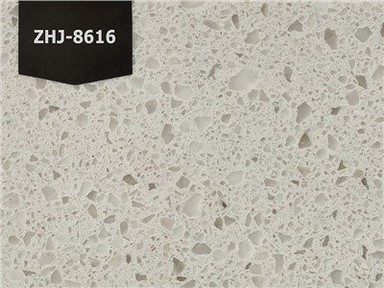
In comparison, quartz countertops are more ordinary in appearance. They can be too grainy, and sometimes, while the sample may look good, the final result after installation is completely disappointing.
So, if you prioritize appearance, stone slabs are definitely your first choice.

Scratch and Abrasion Resistance:
Both slate and quartz have relatively high hardness and are relatively scratch-resistant. Scraping the surface with a wire or hard object leaves virtually no marks. However, if a comparison is necessary, quartz is somewhat inferior to slate. Quartz is made from quartz sand, which has a Mohs hardness of 7. However, because other raw materials are added to create countertops, a qualified quartz countertop (with a quartz content of at least 93%) typically has a Mohs hardness of around 5-6. If the product you purchase has a lower quartz content, the hardness will be even lower.

The Mohs hardness of slate countertops is generally around 6-7, and high-quality ones may even be higher. Experiments have been conducted using a key and a steel ruler to scrape the surfaces of both materials. The results show that neither quartz nor slate countertops can be scratched with a key. However, using a steel ruler does not hold up as well as slate, leaving minor scratches. Darker quartz countertops, in particular, have more noticeable scratches. Even so, quartz is sufficiently scratch-resistant and wear-resistant; after all, no one spends all day chopping vegetables or meat on a countertop with a knife.
Stain Resistance:
Many people report that quartz countertops easily bleed. This is often caused by purchasing low-quality quartz or granite counterfeit. There's a lot of fake quartz on the market, and it's easy to make a mistake if you're looking for a bargain. Genuine quartz countertops are not only scratch-resistant but also water-resistant. Quartz itself has a very low water absorption rate, so there's a slight chance of bleed-through, unless it's tea water. Tea polyphenols in tea are easily soluble in water and fat, and quartz is made from resin. However, as long as you clean it promptly, it's generally fine.

High-Temperature Resistance:
When dishes are served, the tableware can be very hot. If the countertop isn't heat-resistant, it's likely to crack. Quartz stone is made of a material with a high melting point. Generally, even a red-hot pot left on the countertop for a short while won't leave any marks. However, purchasing inferior quartz stone can not only easily warp and crack, but also pose the risk of excessive levels of heavy metals.
As for the high temperature resistance of rock slabs, it goes without saying. Rock slabs are made by firing at high temperatures of 1300-1600 degrees Celsius, so there is no need to worry about deformation, discoloration, or even cracking when they come into direct contact with high-temperature objects.
Durability:
I've praised slate a lot before, but it has a fatal weakness: brittleness. Many friends have experienced this, such as buying a slate dining table that broke in two during transport. Therefore, if you use a slate countertop, you should use a backing plate. Also, be careful with handling, as impact can easily chip a corner. Some people even reported a glass condiment bottle falling over and chipping the tabletop. Therefore, in terms of durability, quartz stone is more durable.

In general, both quartz countertops and slate countertops have their own advantages. Quartz countertops offer a high cost-performance ratio, but it's easy to buy inferior products. Quartz countertops offer excellent performance and a beautiful appearance, but they're expensive and require careful handling. Avoid excessive stress on the countertop and avoid cutting large bones to prevent the slate from breaking. Now, do you know how to choose?